Yuki begins to confront his past in his efforts to move forward – and Akito doesn’t like it.
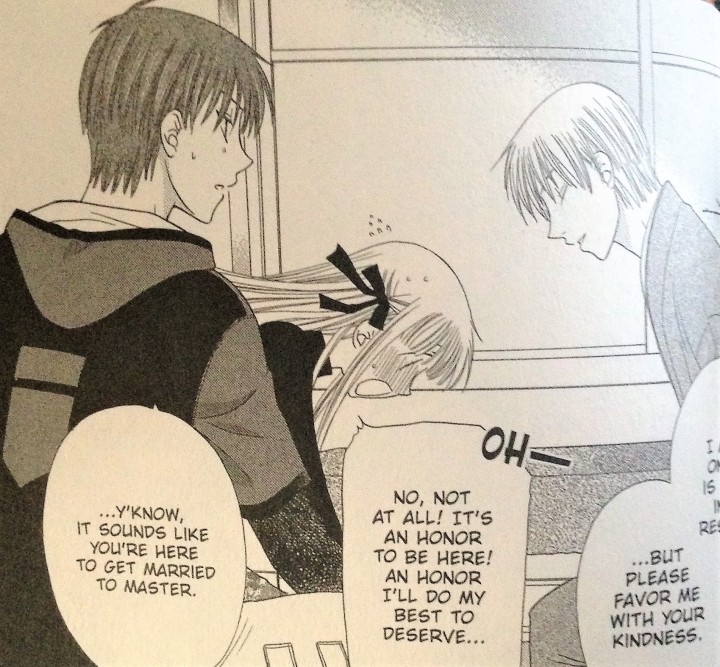
Yuki begins to confront his past in his efforts to move forward – and Akito doesn’t like it.
“What color do you like, Kuragi-san?
That’s right. The instant he asked me that, I didn’t understand the question. I didn’t know who he was. I didn’t know who “I” was. I was “empty”.
Why is a new day dawning? Why do they look like they’re having so much fun? Why is the TV telling me about tomorrow’s weather? Why didn’t the world end the day Katsuya died?
The Hondas quickly settle into their new life together, but of course their happiness can’t last…
The extremely unorthodox courtship of Tohru’s parents continues to be kind of uncomfortable as a not-quite-teacher not-quite-dates his not-quite-student (who is maybe fourteen or fifteen, tops).

Being left behind…or leaving behind. I wonder which hurts more.
Kyo experiences some severe emotional fallout from that play.
The stage is set for Class 2-D’s play, but Yuki and the narrator seem to be the only people who care about fidelity to the source material (or telling a coherent narrative at all).
Now that Yuki’s had a chance to air out his past (and confirm to the audience that his feelings for Tohru are purely platonic), we turn back to Kyo and Tohru, who are both kind of stressed out about the Cinderella play (amongst other things).
This is a rare occasion, so I hope we can put on a good show. Everyone’s working together. And we all owe a debt of gratitude to…
In the beginning, she was just a classmate. Then she was the weird girl who lived in a tent. I invited her to live with us partially because she was in dire straits, but mostly because of some stupid spirit of defiance against the Sohma family and our curse. But something she said got to me.






 Eucatastrophe