Even if the two of us are torn apart – I swear that I will change the world.
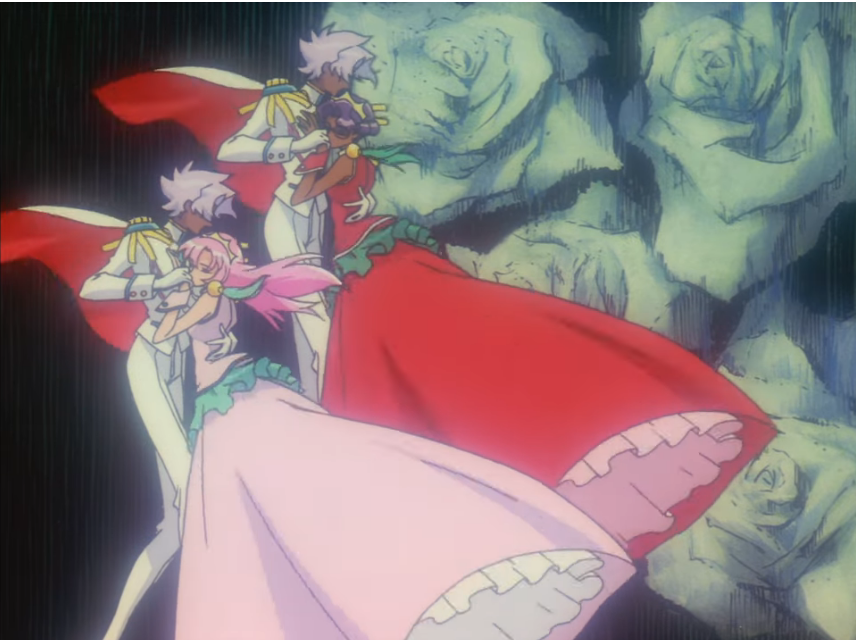
This is a story I’ve had to wrestle with more than any of the others I’ve blogged about (and not just for the queerness, although that definitely played a part). While it might technically contain less “mature content” than Fruits Basket, I would never recommend this to anyone under 16. It gets real dark, but it also proved the existence of the patriarchy to me, changing the way I see the world.
I still feel the need to include some trigger warnings up front, because even though I consider this an important story, you need to know what you’re getting yourself into – it took me two tries to finish it myself. First, there are some flashing lights in every duel (which is generally every episode), and excessive flashing lights in the last episode, so be forewarned. There was featureless nudity in both Furuba and Princess Tutu, but I generally avoided showing it; in this show, I don’t think it’ll be possible to avoid nudity. As far as mature content, there are varying degrees of sexual assault, including a man grooming students in a manner which seems to be fairly realistic, and a weird focus on incest. Also, a brown girl is the target of some truly horrific abuse.
This is the first original anime from Kunihiko Ikuhara (who made his name working on Sailor Moon, like Junichi Sato), and while he has never publicly identified as queer, he’s included queerness in every show he’s made, and just generally makes really compelling stories. But as always with anime, he’s aided by a substantial group of talented people, most notably Yoji Enokido, who collaborated with him on Sailor Moon, including my personal favorite season, SuperS (the fourth one), which he did the series composition for (basically managing the scripts, in addition to writing many of them), a role he reprised in Utena. Enokido continues to write to this day, having been responsible for the Ouran High School Host Club adaptation, and more recently, Bungo Stray Dogs and the latest Gundam show. Intriguingly, Utena was also one of the first shows that Mamoru Hosoda (The Girl Who Leapt Through Time, Wolf Children, Belle) worked on as a storyboarder, so this’ll give me a chance to talk about his work.
As usual, there are other people out there who might be able to interpret the show better (or at least more accurately), I’m mostly doing this because Utena had such an influence on several of my favorite shows, and just because it’s so good! Messy and uneven, but good.
And speaking of influences, one influence on Utena that I’ve rarely heard discussed is Paradise Lost (by John Milton), which I’ve briefly written about before, but it’s literally referenced in the dueling theme! It really makes sense, considering that anime frequently borrows Christian imagery, and Paradise Lost is a very anime-esque retelling of the Bible. I’m also aware that Ikuhara was heavily influenced by the aesthetic of the Takarazuka Revue (an all-female Japanese theatrical troupe), but seeing as I’m not terribly familiar with that, I’ll probably mostly ignore it. Basically, I won’t get every reference in this show, but if you want to comment about it, feel free – I always love learning more about the stories I blog about!
In this case, I will stick to the subtitled version, partly because that’s the version I was first introduced to, but mainly because the dub isn’t great (not a total disaster or unfaithful to the original intent or anything, just not optimal). Ikuhara shows often have wordplay that just doesn’t translate to English. Both versions are free on Youtube, though (the subbed version is here). On another technical note, I will be covering the movie (which is behind a paywall on Retrocrush), because although it’s partly a recap, there’s still plenty of new content to be analyzed.
Grant me the power to bring the world revolution!
Until next time…

