As promised, here’s a little screed comparing the systems of power (both magic and government systems) of The Owl House and Harry Potter, with a particular focus on how these stories handle their respective fascist narratives.
While The Owl House obviously borrowed a lot from Harry Potter, it distinguishes itself not only with its inclusive themes, but because it was clearly making a point about the way oppressive systems are often built to support fascist regimes, and as such, the systems that supported a despot must be torn down as well. In Harry Potter, the systems are presented not so much “good” as “neutral” – just the way things are. The magic element is important primarily because the magic system of Harry Potter is hardly ever interrogated, let alone challenged, even though it results in Harry’s childhood of abuse and neglect. The main aspect I’m interested in is the “love” protection, which is key both to the beginning and end of the narrative. The Owl House, on the other hand, immediately challenges both magical and governmental systems, which are presented as part of the same system of oppression. Luz is forced to perform magic differently than her friends, but that outside perspective helps her see injustices inherent to those systems. Harry, on the other hand, just accepts those systems because he comes from a place of privilege within them.
Let’s start at the very beginning (a very good place to start). As Harry Potter was the first chronologically, I’ll defer to it for once. Harry escapes from an abusive family when he’s (finally) informed by Dumbledore that he’s actually a wizard, and that explains many of the freak “accidents” surrounding him. He’s summarily carted off to Wizarding School, where he makes friends, learns magic, and solves mysteries. Luz, on the other hand, runs away mostly because she feels misunderstood in her hometown and is about to be shipped off to a summer camp that teaches kids to be “normal”; her mom isn’t abusive, just in a tough spot without a clue what else she can do for her daughter. Luz encounters the Owl House and its occupants, Eda and King, and realizes that they don’t fit into their society, either, so she pursues her lifelong dream of becoming a witch by moving in and starting an apprenticeship with Eda. She doesn’t start going to Magic School until about halfway through Season 1, mostly to make friends with other witches her age (and partly to learn from more consistent teachers, as Eda only occasionally remembers to teach her anything).
Immediately, their stories are very different, even just on a personal level. Harry is essentially rescued from an abusive home…by being invited to a boarding school. I don’t doubt that there have been children who had better experiences at school than at home (I personally preferred school to home for much of my childhood), but to be frank, schools generally favor students who are cishet, neurotypical, and at least in a Western context, white. Harry is all of those things. Luz is none. Some students get by with pretending they’re “normal” to blend in (like Calvin from A Wrinkle in Time, or myself), but it will always be impossible for others. Even in Hexside, where skin color doesn’t appear to be an issue, Luz is still bullied for being a human, and her lack of natural magical ability makes it impossible for her to learn magic like other students. Harry is rich and famous at school (as opposed to his family who always treated him as a burden), and Luz, while somewhat infamous for being a human, faces many of the same struggles she had in her old school.
The schools are as good a place to start as any, since both implicitly want to produce “good citizens” of their respective worlds. I won’t delve into the actual classes at Hogwarts, as they’re rarely relevant to the story (and Lily Simpson already covered it extensively in her “Brief Look at Harry Potter” video). No, I’m more interested in the social conditions of the school. Specifically, the House System. Upon arrival in their first year, all students are sorted into one of four houses, each of which values one virtue: Gryffindor (Bravery), Slytherin (Ambition), Ravenclaw (Intelligence), and Hufflepuff (Diligence). Each of these virtues are not inherently good or bad. And each house generally keeps to itself – they take all their classes together, they eat together, they live together. While there are regular two-house classes, the houses are still inevitably distinct. Not helping matters is the Points system, which is ostensibly meant to reward good behavior and celebrate achievements, but we see it frequently abused by professors to favor their own houses. In effect, it only serves to pit all the houses against each other. And Slytherin is immediately framed as the “evil” house, full of evil wizards and their children. While Rowling throws the house a bone at the end by saying that Snape was ultimately a good guy, he’s still treated as an exception, not the norm. Also he was still needlessly petty and cruel to children. But worst of all, Slytherin is EXPLICITLY founded on racism. That house only accepts pureblooded wizards, or occasionally half-bloods, but never Muggle-borns. This is a huge problem, as not only does Slytherin throw together like-minded racists, but then all the other houses are expected to TOLERATE that racism. They’re being taught to coexist with bigotry, and even if Slytherin is demonized by the rest of Hogwarts, they’re still welcome there. They have a place even if it makes certain marginalized groups less safe.
Now, on to Hexside. Instead of Houses, the students are separated into magic tracks depending on their interests/ambitions, with the ultimate goal of joining the associated coven when they’re older (or, for the more ambitious students, the Emperor’s Coven), at which point they have all their other “nonessential” magic sealed away. There might be some stereotypes associated with different tracks (Illusionists generally have a more theatrical flair, for example), but overall, your chosen field of magic has little to do with personality. Students still choose their tracks on the first day, but there doesn’t seem to be much issue with changing tracks if you find that some other track suits you better (as with Willow, who started on the Abomination Track, but was able to switch to Plants instead when she showed more aptitude for it). The various tracks necessarily have (mostly) different classes, so they spend much of their school day with others of the same track, but there are also plenty of clubs and sports, which provide ample opportunity for students of different tracks to interact. The idea at Hexside is for all the students, regardless of track, to live harmoniously with one another, and later for the different covens to coexist together. The means of achieving that (like the Detention Pit) are sometimes questionable, but at least it results in collective school pride rather than pride in your specific track. This is how the school operates up until Luz joins, because she wants to learn about all kinds of magic (except potions), and as such she immediately clashes with the established track system by attempting to “mix magic”. Fortunately, after she and a band of mixed magic practitioners save the school, Luz uses that as leverage to allow multi-track studies for any student who desires it. At first, it’s just Luz and her little band that avail themselves of this program, but over time we see several more students join in. While Harry happily buys into the House system (because it suits his desires), Luz immediately rebels against the Track/Coven system because it stifles her curiosity, and makes an actual change for the sake of others like her (and like Eda, as we eventually discover).
Next, we’re going to be delving into the meat of the stories, and as such, SPOILERS AHOY!
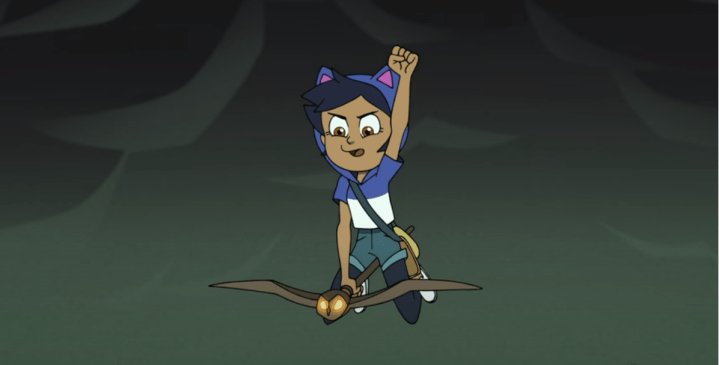
Now, onto our protagonists interactions with the government. While Harry does technically break the law in the second book (and breaks rules at Hogwarts all the time), he’s never seriously called to account for his actions until the fifth book, due to a change in leadership. To be fair, his first legal offense (“borrowing” and wrecking a flying car) was mostly a panicked response to unprecedented events, however, it’s still telling that his friend Ron receives the brunt of the blame for that incident, ostensibly because “he should know better”. The events of the third book are a different story, when he accidentally (but by no means unintentionally) blows his abusive aunt up like a balloon and sends her flying. This is a much more serious offense, and he only gets out of it because the authorities consider his safety to be a more pressing concern than punishing him as his crimes deserve. And when he IS finally held accountable for a “crime” in the fifth book, he’s clearly framed as in the right, as the offense ultimately amounts to self-defense in the face of potentially lethal danger, and the prosecutor is LITERALLY a villain trying to discredit and neutralize him. School authorities may occasionally discipline him (mainly when he needlessly puts his life in danger), but more often than not Harry’s safety takes precedence over justice. After all, half the time his breaking the rules saves the school…but that’s more an indictment of the school and its faculty than anything else. If it has to be rescued regularly from disaster by a couple of CHILDREN, maybe you need to replace a few people. But the government is always on his side, except when it’s overrun by evil people.
“But wait!” you may be saying, “Didn’t Luz also break the rules to save the school?” Why, yes! ONCE. In the wake of a sudden and unforeseeable attack. Don’t get me wrong, Luz does occasionally break rules that shouldn’t be broken, but the show generally frames those as BAD DECISIONS. And it’s more often disobeying Eda than breaking rules. Because they do break the law a LOT! Eda’s a wanted criminal, after all. The very first episode features Luz starting a prison riot, precisely because so many of the Emperor’s laws are unjust. The Coven System is part of the government, made to control potentially dangerous witches, and funneling in the best to the Emperor’s Coven. Hence, Eda’s main crime is refusing to join a coven. Honestly, we’d be here all day if I tried to recount every time Luz or Eda broke the law (because it’s pretty much the whole show), but that’s the point. The Owl House doesn’t fit into the society Belos created, so they must inevitably break the law to survive. Just as morality cannot be legally enforced, neither is lawbreaking necessarily evil. Even Harry Potter implicitly supports this notion, as when the fascists take over, Harry and his friends become wanted criminals, too. But he never doubts the system in general, because it always had his back in the past, so he just returns it all to normal, the way it was when it was on his side, never considering that the way things were wasn’t equitable for everyone.
Now, onto the magics. Each of these stories have standard spellcasting procedures learned in school, but I’m not terribly interested in those. In Harry Potter, you learn a spell, you wave your wand properly, and that’s it. But the story delves into murkier territory with what I’ll call “blood magic” (though it’s never called that within the text): The protective charm that’s activated when one person dies for the sake of another (or a group, as is confusingly the case in the last book). “Love” is ostensibly the key component, but you cannot convince me that Harry loved every single person at Hogwarts. He likely didn’t even KNOW all of them! But back to the point, the plot was first kicked into motion when Harry’s mother died for his sake, resulting in a charm that protected him as long as he lived with her blood relatives, namely his aunt (her sister), uncle, and cousin. He was protected from death, but not the abuse and neglect her family inflicted on him. And while his uncle is pretty irredeemable throughout the series, Harry’s actual blood relatives (his aunt and cousin) eventually reconcile with him, because I guess the good blood won out? The focus on blood and family of origin does actually carry over to Voldemort, too – he’s the Heir of Slytherin because he’s a descendant of Slytherin, and therefore just as racist! But the most offensive thing to me is the implication that because his parents didn’t truly love each other, he’s incapable of love himself. My own parents clearly didn’t love each other for as long as I can remember (they eventually divorced, much to my relief). That situation made loving difficult, but hardly impossible. But it’s not the way Voldemort was raised, because he was orphaned when he was still a baby, hence the only way for his parents to have so much of an impact is through the blood itself. That’s not even getting into the fact that there’s obviously a genetic (“blood”) component to magical aptitude as well. This implies that it’s more important for a child to be raised by blood relatives than that the people raising him love and care for him, because deep down, they must ACTUALLY love him because he’s their blood, right? And the sad thing is, Harry only questions this magically enforced arrangement briefly in the first book, when he’s first made aware of the situation, but ultimately defers to Dumbledore and accepts his only marginally better home life because it builds character or something. You cannot convince me that they knew Harry was living in a closet, but was totally unable to intervene in his home for a decade. And even when he’s grown, Harry never considers the damage that this sort of magic could (and visibly DOES) do to children, because HE survived it, so why can’t others? This emphasis on blood ties is further reinforced at the very end, when both Harry and Hermione marry into the Weasley family, making their chosen family their “real” family.
Of course, just as the Owl Family complicates the laws of their world, so too do they rebel against the magic system in various ways. Luz, besides pursuing multiple tracks of magic, also disrupts the system just by being a human in that world. She’s told early on that she lacks a biological component that the residents of the Boiling Isles evolved in order to use magic, but she manages to perform magic upon rediscovering an ancient spellcasting technique, glyphs. Eda eventually theorizes that if you have the right combination of glyphs, you can cast any spell, which implies that all magic in the Demon Realm is derived from glyphs. Eda herself has a curse that corrupts her own magic, eventually resulting in the loss of her innate magical power at the end of Season 1, forcing her to use glyphs as well. While Eda has long opposed the Coven System on the principle of freedom, they don’t actively plot to destroy it until they discover its true purpose: To annihilate all the residents of the Boiling Isles. Ironically, Lilith originally cursed her as a means to ensure her own spot in the Emperor’s Coven, but Eda weaponizes that magical corruption against the Emperor, almost disrupting the Day of Unity spell. King, however, is the one who ultimately stops the spell, despite spending the first season being the only member of the Owl House without magic powers, after discovering that he’s actually a Titan, the son of the gigantic creature upon whose corpse the Boiling Isles are founded. And in the final episode, all three of the residents of the Owl House (Eda, King, and Luz) end up defeating Belos together, ending his reign and the Coven System.
The epilogue of Harry Potter features the main characters as adults, doing much the same things as the generation before, with the implication that this is the way things should be, despite the utter failure to reform (or even interrogate) the systems that allowed fascism to take over in the first place. The epilogue of The Owl House (basically the end credits/post credit scenes of the final episode) feature the main characters pursuing entirely new things, because destroying the systems also destroyed things that were limiting them, even if some of them lost power in the process.
Harry Potter presents the popular conservative narrative that fascism is always a threat from people outside of the system, and that once all the “bad people” are replaced with “good people”, we can safely go back to the way things were. The Owl House presents a more realistic narrative, that fascism establishes its own systems to support itself, and they must be dismantled in order for freedom to reign, and that often requires sacrifice. Harry Potter exemplifies the worldview of privilege; Luz and her Owl Family the perspective of the misfit.
Until next time…
 Eucatastrophe
One thought on “Breaking the (Magic) System: What The Owl House understood (and Harry Potter didn’t)”